



Every year, around 8 million tonnes of plastic end up in our oceans, the equivalent of a lorryload of plastic waste every minute. This plastic doesn’t disappear, it pollutes our seas, our soil, and sometimes ends up on our plates, endangering our health and that of our children. Today, it is increasingly difficult to turn a blind eye to the scale of plastic pollution. Plastic is ubiquitous in food packaging and disposable objects, and it is having a devastating impact on the planet, wildlife and biodiversity. More than 700 marine species are directly threatened by plastic waste, with thousands of animals dying every year.
Faced with this dramatic situation, we urgently need to find sustainable, alternative solutions. One such solution, often overlooked but full of potential, could well be raffia fiber. Used for centuries to make craft and agricultural items, this plant fiber could become a viable alternative to plastic and help protect our planet. This article explores the potential of raffia and the challenges to be overcome before it can be adopted on a large scale.
What is a bioplastic ?
Before taking a closer look at raphia as a bioplastic, it’s vital to understand what bioplastics are and why they represent a response to plastic pollution. They fall into two broad categories: biosourced bioplastics and biodegradable bioplastics.
Biobased bioplastics are made from renewable raw materials, such as plants, algae or other biological sources. For their part, biodegradable bioplastics have the advantage of decomposing naturally in the environment, limiting their impact on ecosystems. Because of these properties, these materials are a much more environmentally friendly alternative to conventional plastics, which have a lifespan of several centuries and are a major cause of ocean pollution and the destruction of marine fauna.


Raffia, a potential bioplastic
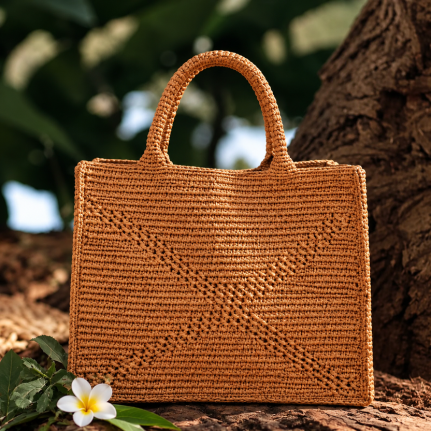
Raffia, also known as “raffia palm”, is a plant fiber obtained from the leaves of certain species of palm trees, mainly found in tropical regions. Although this fiber has been used for centuries in handicrafts, to make cords, bags and decorative objects, its potential in the manufacture of bioplastics is still largely underexploited.
In addition, it is rich in cellulose, an essential organic molecule in the production of biodegradable plastics. This richness in cellulose makes it a natural candidate for the development of bioplastics. However, for it to become a large-scale solution, a number of factors need to be taken into account.
Why is raffia a good candidate ?
Raffia has a number of major advantages when it comes to being converted into bioplastics. Firstly, it is an abundant, easily cultivated and renewable resource. Compared with other agricultural raw materials, raffia does not require specific conditions and can be grown in many tropical environments.
From a technical point of view, the cellulose extracted from raffia is particularly effective for making films and biodegradable plastics. These films could be used in various sectors, including packaging, where traditional plastics are massively used. However, more needs to be done to overcome the challenges of transforming raffia into a high-performance bioplastic.
The challenges of using raffia as a bioplastic
One of the main challenges lies in processing raffia to extract the cellulose efficiently and cost-effectively. Unlike more common sources of cellulose such as wood or cotton, the process of extracting and converting raffia into bioplastics still requires innovation to be viable on a large scale.
In addition, the mechanical strength and flexibility of raffia-based plastics need to be improved so that they can compete with traditional plastics used in applications such as food packaging and everyday consumer products.
In conclusion, although progress is still needed to overcome current technical and logistical obstacles, raffia represents an immense potential for reducing plastic pollution. Because of its availability, durability and biodegradability, it could play a key role in the transition to more sustainable, environmentally-friendly materials.
Why is raffia making a strong comeback in international fashion in 2026?
Long associated with local craftsmanship or summer accessories, raffia is…
Behind a BLESSED accessory: the hands that create
Before becoming a bag, a basket or an accessory, every…
Handmade or machine-made: what consumers should know
In a world where everything moves fast, where industrial production…